Human-in-the-Loop AI Outbound: Why Full Autonomy Needs a Review Gate
October 8, 2025 · 5 min read · by Ahmet Faruk Yilmaz, Founder of Asphia
TL;DR
Full AI autonomy in outbound skips a review gate that can flag hallucinated claims, wrong personas, and tone mismatches before sending. A human approval step adds control, but it cannot guarantee accuracy, inbox placement, or sender reputation.
The promise of AI outbound is seductive: generate a thousand personalised cold emails overnight, hit send at dawn, and wake up to a calendar full of meetings. The practical risk is that a fully autonomous send can skip context and review; the effect on a sending domain depends on the audience, provider and execution.
Human-in-the-loop AI outbound adds one approval step between AI generation and live send. That step can catch errors no prompt fully prevents, but it does not guarantee deliverability or accuracy.
Why AI-Generated Copy Fails Without a Review Gate
Modern language models are very good at sounding confident while being factually wrong. In cold outreach, a hallucinated statistic, a mis-attributed quote, or a personalization hook pulled from the wrong contact record may produce a poor reply, a spam complaint, an unsubscribe, or a public reply calling out the error. Those signals can affect sender reputation depending on provider and audience context.
The failure modes cluster into three categories.
Factual errors are the most visible. An AI told to reference a prospect’s recent funding round might pull a number from a different company or a stale source. The prospect notices immediately.
Tone mismatches are subtler. A message written for a growth-stage SaaS founder lands very differently when routed to a compliance officer at a regulated financial firm. The copy is technically correct but contextually wrong.
Persona errors happen when the data pipeline and the copy engine are not in sync. The enrichment tool tagged a contact as “VP Sales” but she moved to a board advisory role six months ago. The AI wrote a message about hiring SDRs. She replies to say she does not have that budget anymore, and your reply rate metric now includes a soft negative.
A human reviewer catches all three in under thirty seconds per message.
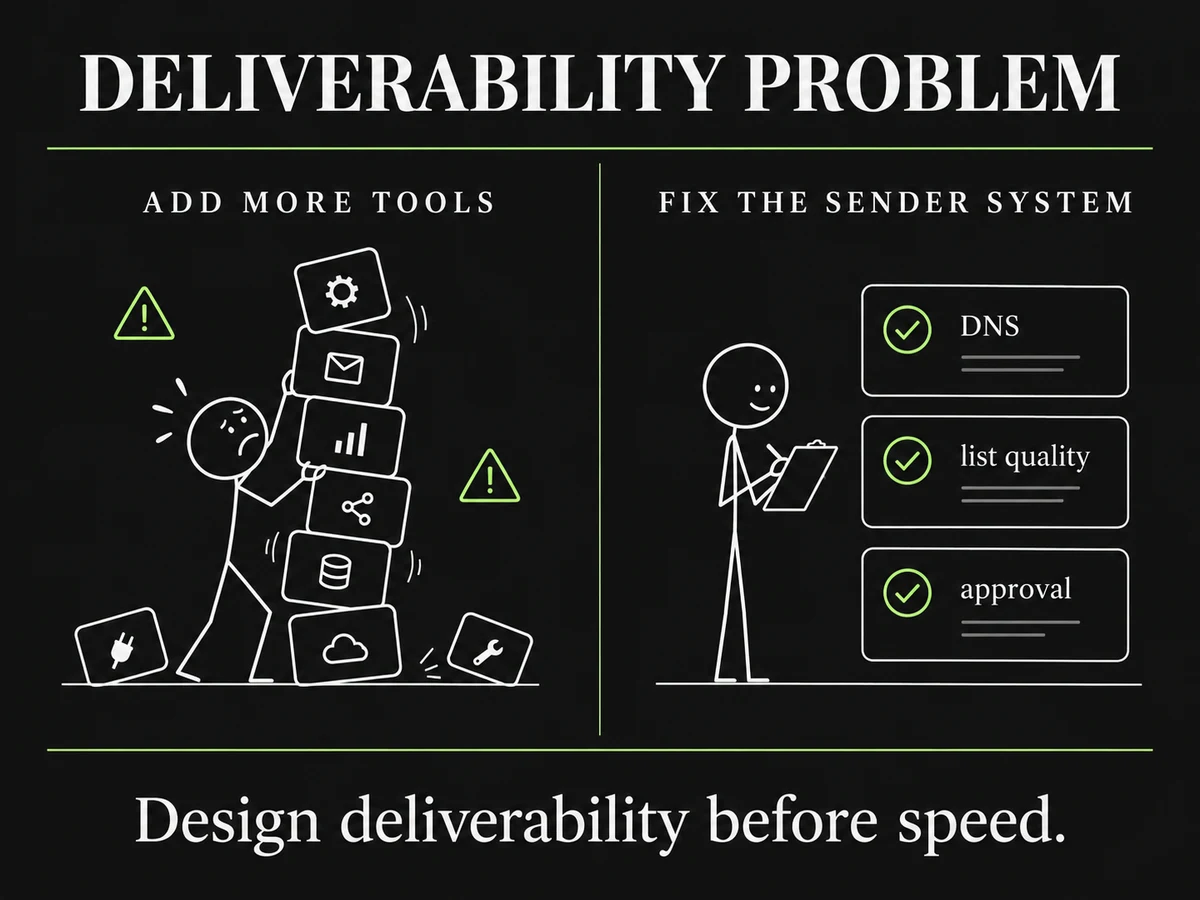 Design deliverability before speed.
What the Review Gate Actually Looks Like at Production Scale
The misconception is that human review means a human sits at a keyboard and types every message. It does not. The AI generates, enriches, fact-checks (often with a second independent model), and queues. The human opens a dashboard, reads ten messages in a batch, clicks approve or edits the one that feels off, and closes the tab.
At Asphia’s managed outbound service, the review step is asynchronous. Approved messages are held until the sending window opens. The human is not a bottleneck because the pipeline is always one day ahead.
For teams building this internally, the same pattern applies. The done-with-you outbound model means the infrastructure lives in your stack and your team owns the gate. The AI does the heavy work. Your judgment protects the domain.
The Domain Health Argument: One Complaint vs. One Month of Repair
ESP warming curves are not linear. A domain that took eight weeks to warm to five hundred sends per day can lose that placement overnight if three contacts in one sending block mark messages as spam. Rebuilding requires dropping volume, re-warming from lower limits, and potentially switching IP pools.
The math is asymmetric. A human review gate that costs two minutes per batch prevents weeks of reduced pipeline. Full autonomy trades a small daily efficiency gain against an infrequent but catastrophic domain reset.
This is why sender reputation is a first-class concern in GDPR-compliant cold email programmes. Complaint rates are not just a deliverability metric. Under some interpretations they are also an indirect signal of consent and relevance, both of which have regulatory implications in European markets.
Layering AI Audit Before Human Review
The most efficient architecture stacks two checks before the human gate: an automated fact-audit using a separate model (not the one that generated the copy), then human approval.
The AI audit compares each claim in the copy against the source data that was used to generate it. Claims about the prospect’s company, recent news, or stated pain points are scored for support. Anything unsupported gets flagged. The human then sees a pre-screened queue where the obviously wrong messages are already marked.
This reduces the cognitive load on the reviewer significantly. Instead of fact-checking from scratch, they are editing and approving. The gate becomes faster, not slower, as the audit layer matures.
The same principle applies to the enrichment layer. Signal-based outreach built on Clay enrichment passes structured data into the generation prompt, which reduces the surface area for hallucination in the first place. Verified data in, audited copy out, human approval before send: that is the full loop.
Full Autonomy Has One Valid Use Case
Automated follow-up sequences that are not personalised beyond the first name and company can run without a human gate, because there is no dynamic claim to verify. A reminder email sent three days after the first touch, referencing nothing specific, carries low risk.
Anything involving a personalisation hook, a reference to recent company news, a stated pain point, or a vertical-specific claim needs a human eye. The line is not about AI capability. It is about the cost of error in the specific message.
For AI SDR programmes at startups where the founder is also the reviewer, a thirty-minute morning review of the previous day’s generated queue is enough to keep a full outbound programme running safely at meaningful volume. The machine runs overnight. The human approves at breakfast. The pipeline stays clean.
Human-in-the-loop is not a limitation on AI outbound. It is the design decision that keeps it working.
Request the signal tier list.
A practical view of how we rank observable signals before outreach. We review each request for fit and may reply by email; delivery is not automatic.
By submitting, you agree to processing described in our Privacy Policy.
Your request was submitted. If it is a fit, we may follow up by email.
One more step: send the prepared request to faruk@asphia.consulting
FAQ
What does human-in-the-loop mean in AI outbound?
It means a human reviews and approves each AI-generated message before it sends. The AI handles research, copy generation, and scheduling. The human checks for factual errors, tone mismatches, and persona fit. This can reduce avoidable errors, but it does not guarantee deliverability or prevent every harmful message.
Why can full AI autonomy create sender-reputation risk?
Autonomous systems may send hallucinated claims, mis-targeted copy, or personalization that feels robotic at scale. Depending on recipient and provider behavior, complaints or poor engagement may contribute to throttling or weaker placement. Review the evidence and provider signals before changing volume.
How much time can a human review gate add to outbound?
Timing depends on batch size, message complexity, reviewer availability and the agreed approval cadence. The workflow can queue drafts for review, but the operating scope should define when a batch is approved rather than assuming a fixed turnaround.
Can you automate the fact-check step instead of using a human?
You can add an independent AI audit layer that checks claims against source data before the message reaches the human gate. This may flag some unsupported claims and reduce reviewer effort, but it can miss errors. The human still approves or edits the message.
What gets caught at the human review gate that AI misses?
Tone mismatches for high-trust verticals (finance, legal, healthcare), claims that are technically sourced but contextually wrong, cultural nuance in multilingual copy, and persona-fit errors where a VP-level message was routed to an analyst. Their frequency and impact vary by model, data and workflow, so measure them during review rather than assuming they are rare.
Is human-in-the-loop outbound GDPR compliant?
A human gate does not by itself satisfy GDPR, but it makes compliance easier to enforce. The reviewer can catch missing opt-out language, wrong jurisdiction data, or contact records that should have been scrubbed. Pairing the gate with a verified suppression list and lawful basis documentation is the full picture.

Ahmet Faruk Yilmaz
Founder of Asphia. He builds and runs signal-based B2B outbound engines for lean teams, and writes about cold email, Clay, deliverability, and GTM engineering.
Want this run for you?
Explore our B2B outbound and GTM engineering services, then request the planning framework to scope your next campaign.
Request the planning framework →