5 Artisan AI Alternatives That Give You More Control Over Outbound
September 30, 2025 · 5 min read · by Ahmet Faruk Yilmaz, Founder of Asphia
TL;DR
Artisan AI automates outbound with an AI SDR called Ava, but many teams find they have little visibility into what goes out or why. Alternatives like Asphia, Clay-built agencies, and modular outbound stacks give you signal-based targeting, human approval gates, and an engine you actually own.
Artisan built its offer around a fully autonomous AI SDR. The tradeoff is a system that can be difficult to inspect, tune, or own.
The alternatives below offer signal-based personalization, human approval before sending, and a stack you still control after the engagement ends.
Why Teams Move On From Artisan AI
Artisan’s core promise is an AI SDR that handles research, writing, and sending in one product. The problem is the gap between automation and good execution.
Cold email that converts does not come from filling variables into a template. It comes from timing a message to a real signal (a new hire, a funding round, a job post, a tech change) and framing it around a specific pain that the prospect is likely feeling right now. Automation without signal awareness produces volume without relevance.
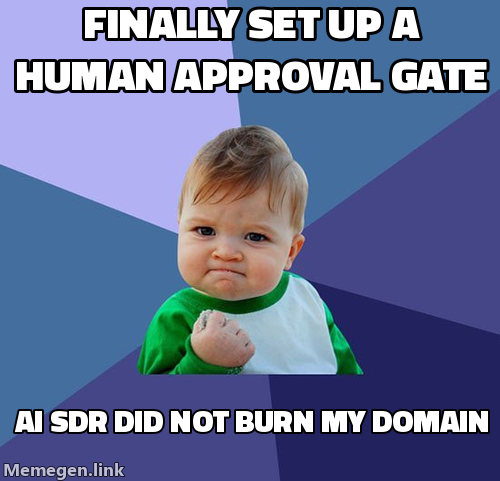 The only gate that matters in outbound.
Ownership is the other issue. Cancel a subscription-based AI SDR and you leave with a contact list, but no system. Build the engine inside your stack and the infrastructure stays with you.
The 5 Alternatives Worth Evaluating
1. Asphia (Done With You or Done For You)
Asphia is an AI-run B2B outbound agency focused on signal-based cold email and LinkedIn. Its workflow pulls data from Clay and Apollo, enriches and verifies every contact, generates copy from real signals, and requires human approval for every send. Nothing goes out autonomously.
There are two engagement models: Done For You (Asphia runs the machine for you) or Done With You (the system is built inside your stack and handed over). Either way, the infrastructure is yours to keep. Sequences are typically live inside seven days. The operation is GDPR-native and supports English, Dutch, German, Turkish, and Arabic outreach.
This model combines agency accountability with a system you own. It is the closest comparison to Artisan, but its operating model is based on transparency rather than automation theater.
2. A Clay Agency Plus Sending Infrastructure
Clay has become a standard tool for enrichment-based outbound. It pulls data from dozens of sources, runs waterfalls to verify emails, and builds the personalization layer that most AI SDRs claim to provide.
Clay alone is not an outbound system. You need a sending tool (Smartlead, Instantly, or Lemlist), a copy layer, and someone who can connect them. A managed outbound service built on Clay handles that setup while retaining the signal depth. Its output is more targeted than Artisan’s templated approach at scale.
3. A Fractional SDR With a Modern Stack
For teams that do not want to automate the human judgment out of outbound entirely, a fractional SDR service is worth considering. A fractional SDR brings a real person who sources, researches, writes, and sends, supported by AI tooling for speed. The personalization quality is higher and the feedback loop is tighter.
This works especially well for enterprise targets where a single deal justifies the cost of genuine research, or for consulting firms and professional services where the sales conversation requires nuance from the first touch.
4. Instantly or Smartlead With a Strong Prompt Layer
If your need is primarily infrastructure and you have someone who can write and manage sequences, Instantly and Smartlead are mature sending platforms with good deliverability tooling. They do not write the emails for you and they do not personalize beyond what you build, but they give you full control over the sending operation.
Pair either with a Clay enrichment layer and a disciplined copywriting process (signal-to-pain-to-CTA structure) and you will outperform a fully automated platform on reply rate. The tradeoff is internal time. See the Instantly vs Smartlead comparison if you are choosing between them.
5. A Niche B2B Lead Generation Agency
If you operate in a specific vertical or geography, a specialist agency will outperform a horizontal AI SDR platform. Artisan was built to work generically across industries. A B2B lead generation agency for Europe, for example, understands inbox placement across German, Dutch, and French domains, knows which data providers have accurate contacts in those markets, and can write copy that reads locally rather than translated.
Market context affects replies. A generic AI SDR does not know that a Dutch CFO responds differently than a US one, or that certain regulated industries require a compliance-aware first line.
What to Check Before You Commit to Any Alternative
Before signing with any outbound provider or platform, ask three questions.
First, what signals power the personalization? If the answer is industry, company size, and job title, the tool is doing demographic targeting, not signal-based outbound. Real signals include recent job changes, open roles, funding rounds, technology installs, and content engagement.
Second, who approves what goes to prospects? A human approval gate is the difference between a system that learns and a system that burns your domain. According to sender guidelines from Google and Microsoft, reputation damage from low-engagement bulk sends is cumulative and hard to reverse. Read Google’s Email Sender Guidelines before committing to any autonomous sending tool.
Third, what do you own after the engagement? Sequences, copy, enrichment workflows, and sending infrastructure should be transferable assets. If the provider owns the system, you are renting outcomes rather than building a durable asset.
For B2B SaaS companies or any team running outbound at volume, the compounding value of an owned system is worth more than the convenience of a black-box SDR, especially when the black box produces mediocre results at a premium price.
Get the signal tier list in your inbox.
We rank signals from S to D to decide who gets a cold email and who does not. You get the list once. No follow-up emails.
Request received. The list lands in your inbox within 24 hours.
One more step: send the prepared request to faruk@asphia.consulting
FAQ
What is Artisan AI and what does it do?
Artisan AI is an outbound platform centered on an AI SDR called Ava that automates prospect research, email writing, and sending. It targets teams who want fully automated outbound without building their own stack.
Why do people look for Artisan AI alternatives?
Common reasons include limited transparency into what emails go out, lack of signal-based personalization beyond basic firmographics, difficulty adapting the system to niche ICPs, and pricing that does not match early-stage budgets.
What should I look for in an Artisan AI alternative?
Look for human approval gates before sending, signal-based personalization (hiring, funding, tech stack, intent), clear data sourcing, GDPR compliance, and the option to own the system rather than rent a black box.
Is Clay a good alternative to Artisan AI?
Clay is a data enrichment and workflow platform, not a full outbound system on its own. Paired with a sending tool and a copywriting layer, it can power more targeted outbound than Artisan, but it requires more setup or a Clay agency to run it.
Can small teams use these Artisan AI alternatives, or are they enterprise-only?
Most alternatives on this list work for teams of one to fifty. Signal-based outbound and managed services are often more cost-effective for small teams than full platform licenses, because you only pay for what you actually send.
How long does it take to get an outbound system running with an agency alternative?
A well-run outbound agency or done-with-you setup can have the first sequences live in about seven to fourteen days, including ICP definition, data build, copy, and technical deliverability setup.

Ahmet Faruk Yilmaz
Founder of Asphia. He builds and runs signal-based B2B outbound engines for lean teams, and has booked meetings with teams at companies across five markets. Writes about cold email, Clay, deliverability, and GTM engineering.
Want this run for you?
Get a free GTM analysis. We show you the exact engine we would build.
Get your free GTM analysis →