Waterfall Email Enrichment: How to Find More B2B Emails Without Paying for One Bad Provider
August 29, 2025 · 4 min read · by Ahmet Faruk Yilmaz, Founder of Asphia
TL;DR
Waterfall email enrichment runs a contact list through multiple data providers in sequence, using the next provider only when the previous one fails. Measure verified match rates on a representative sample; results vary by segment, provider, and data quality.
If you run outbound at any scale, you may encounter incomplete enrichment results. A list from Apollo or LinkedIn can return some usable emails and some blanks after a single provider pass. You can investigate a second provider or accept an incomplete list.
Waterfall email enrichment addresses this by chaining multiple providers in sequence, so a later provider can be tested against gaps left by an earlier one.
What a Waterfall Actually Looks Like
The concept is simple. You take a contact (name plus company domain) and pass it to Provider A. If Provider A returns a verified email, you stop and move on. If it returns nothing, you pass the same contact to Provider B. Then Provider C if needed. You stop the moment any provider succeeds.
The result is a unified output that can combine the providers you select. Pricing and billing rules vary by provider, so confirm whether charges apply to successful returns, credits, or other usage events.
A three-provider waterfall for a B2B SaaS ICP may start with a broad provider, followed by providers selected for gaps seen in your own sample. Verify the current provider capabilities and measure verified match rates for your target segment before choosing the order.
Why Single-Provider Enrichment Underperforms
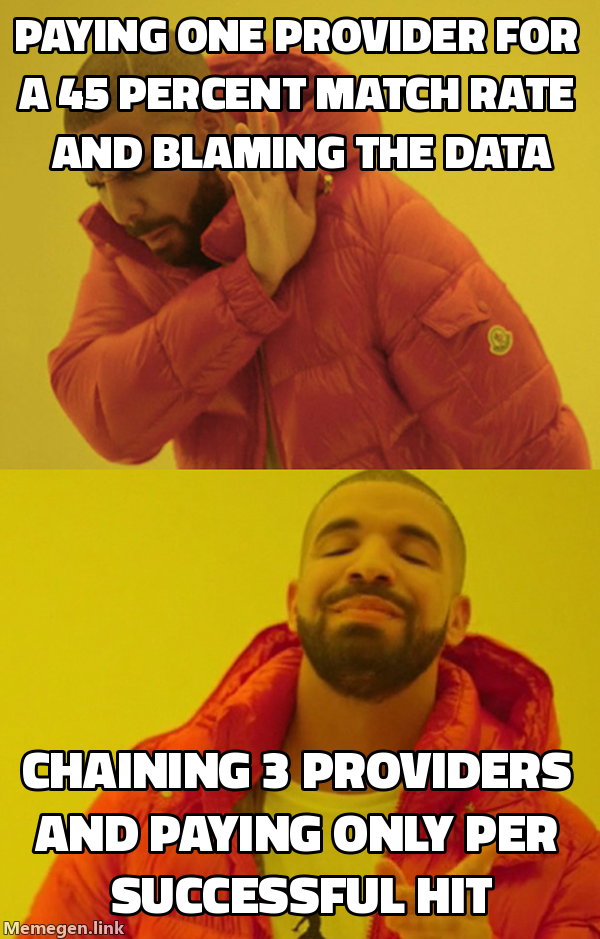 One provider, one coverage map, one ceiling. Stack them and you stop hitting it.
Data-provider coverage varies by company size, geography, industry, and data-source quality. A provider that performs well for one ICP may perform differently for a mid-market professional-services segment in Germany or the Netherlands.
The differences can become more visible with narrow persona targeting. If you are reaching VP-level contacts at 50-person companies in Southern Europe, evaluate each provider’s verified coverage on a representative sample rather than assuming any database has reliable density.
Waterfall enrichment is one way to test complementary provider coverage for multi-geography or multi-persona outbound. Its value depends on the incremental verified coverage, cost, and operational burden.
For agencies and teams running clay enrichment service workflows, verify the available waterfall features in the current product documentation. Teams building their own stack can also implement sequential provider calls with an automation platform or code.
Verification Is Not Optional
One mistake teams make after building a waterfall is treating the output as send-ready. It is not.
Waterfall enrichment maximises find rates. It does not guarantee that the found email is deliverable today. People change jobs. Domains go dormant. Catch-all servers accept anything thrown at them, which tricks enrichment providers into reporting a valid result.
Use a separate verification step and a documented sending policy before any outreach. Verification tools can classify results such as valid, invalid, catch-all, or unknown; review their current definitions and limitations. Treat catch-all results as a separate risk decision, balancing potential bounce risk against list coverage.
Sending an unverified output can increase bounce risk and harm sender reputation. Test and monitor the impact of verification against your own sending policy.
Building the Stack Order
The provider order can affect cost and coverage. Use current provider pricing and representative test results to choose an order; place specialised providers later only when that is supported by your evidence and economics.
A practical approach is to test provider performance on a representative sample of your actual ICP before committing to a production stack order. Run the sample through each provider individually and record match rates, verification outcomes, cost, and compliance considerations side by side. Choose the first provider based on those results rather than a universal rule.
This also shows whether an additional provider meaningfully improves verified coverage. Additional providers can add cost and complexity without enough incremental benefit; use your test to define the stopping point.
For teams running done-with-you outbound builds, include sample testing as a planned data-infrastructure step before a campaign goes live.
What to Do With the Blanks That Remain
Even a waterfall that performs well on a sample can leave contacts unmatched. Causes can include limited source coverage, incomplete contact data, and provider-specific constraints.
For these blanks, you have a few options. LinkedIn outreach through a tool like HeyReach bypasses the email requirement entirely for contacts where the LinkedIn profile is the primary reachable surface. Manual research using the company domain pattern (the format every other contact at that company follows) can recover a portion of the blanks at low volume. Or you accept the unmatched contacts as unworkable for this channel and focus your sending on the verified-email segment.
The goal is not a 100 percent match rate. The goal is a high-quality, verified contact list that keeps your sending infrastructure healthy and puts relevant messages in front of people who are genuinely a fit for what you offer.
A waterfall can improve coverage where providers have complementary data, but it adds cost and operational complexity. Use a representative, verified sample to decide whether the additional providers improve your result enough to justify them.
If you want a managed outbound service that handles enrichment waterfall, verification, and sending infrastructure as a complete system, that is what the outbound we run at Asphia is built on.
Request the signal tier list.
A practical view of how we rank observable signals before outreach. We review each request for fit and may reply by email; delivery is not automatic.
By submitting, you agree to processing described in our Privacy Policy.
Your request was submitted. If it is a fit, we may follow up by email.
One more step: send the prepared request to faruk@asphia.consulting
FAQ
What is waterfall email enrichment?
Waterfall email enrichment is a method where a contact list passes through multiple email data providers in sequence. Each provider attempts to find the email. If the first provider returns nothing, the next one tries. You stop the chain the moment you get a verified result, which keeps costs down while maximising match rates.
What match rate can I expect from a waterfall approach?
There is no supported universal match-rate range. Measure verified match rates on a representative sample of your target persona; results vary by segment, geography, provider, and data quality.
Which providers should I include in my enrichment waterfall?
Common choices include Apollo, Prospeo, Hunter, LeadMagic, and BetterContact. Provider coverage and capabilities change, so compare their current documentation, commercial terms, and verified results on your specific ICP before committing to a stack order.
How does waterfall enrichment differ from using Clay?
Clay can orchestrate a waterfall enrichment workflow. You can also replicate the logic with custom code or automation tools. The operational effort, provider integrations, and results depend on your implementation and verification policy.
Do I need to verify emails after waterfall enrichment?
Verification is a prudent control because enrichment does not guarantee current deliverability. Establish a verification policy before sending and handle catch-all or unknown results separately, as they can carry additional bounce risk.
Is waterfall email enrichment GDPR compliant?
Whether enrichment and outreach are lawful under GDPR depends on the data, purpose, jurisdictions, and safeguards. Document your assessment, check provider terms and data sourcing, honour data-subject rights, and obtain legal advice before processing EEA contact data.

Ahmet Faruk Yilmaz
Founder of Asphia. He builds and runs signal-based B2B outbound engines for lean teams, and writes about cold email, Clay, deliverability, and GTM engineering.
Want this run for you?
Explore our B2B outbound and GTM engineering services, then request the planning framework to scope your next campaign.
Request the planning framework →