Trigger-Based Outbound vs Spray and Pray: How to Test Signal Sequences
April 22, 2026 · 5 min read · by Ahmet Faruk Yilmaz, Founder of Asphia
TL;DR
Trigger-based outbound email uses an observable company event, such as a new hire or job post, as research context. Test it against a comparable generic sequence: outcomes depend on the account, offer, data quality, channel, and execution.
Spray-and-pray outbound is easy to describe: build a list, send the same email to everyone, hope something sticks. Trigger-based outbound email is the opposite. You watch for a specific event that signals a live problem, then send a message that speaks directly to that moment.
Signal context can make a message more relevant, but it does not guarantee a reply. Use a parallel, comparable test to measure whether it changes outcomes for your segment and offer.
What Makes a Signal Worth Acting On
A signal is any observable event that shifts a prospect from “probably fine” to “actively trying to solve something.” The most actionable ones in B2B are:
- A new executive hire (research whether the change is relevant)
- A funding announcement (research whether it changes current priorities)
- A job post for a role your product replaces or supports
- A technology change detected via tools like BuiltWith or Datanyze
- An expansion into a new geography or vertical
The key word is observable and verifiable. Public signals can inform research, but they do not establish a lawful basis or permission to contact someone. Check data provenance, applicable channel rules, provider terms, suppression, and your compliance process before outreach.
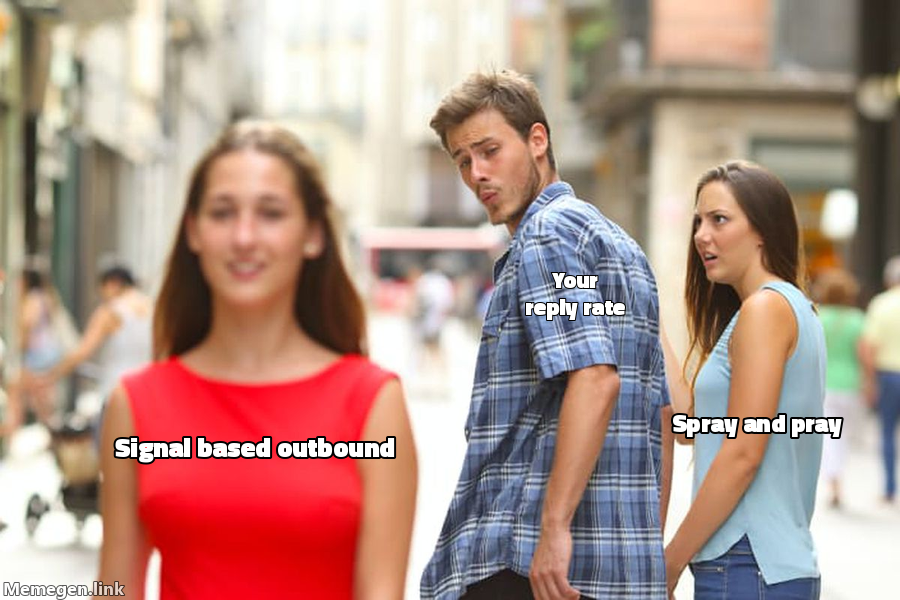 Measure the outcome; do not assume the winner.
Limits of Generic, Static Sequences
Generic, static sequences can lose timing and relevance as a list ages.
Timing first: a static list built in January is cold data by March. The person you emailed may have changed roles, already bought a competitor, or just gone through a funding round that makes them a perfect target. You have no way to know because you are not watching.
Relevance second: a generic pitch to the whole list treats a 10-person startup the same as a 400-person growth-stage company. The problems are different, the budget cycles are different, and the decision process is different. A message that tries to speak to everyone speaks to no one.
Signal context can address those risks when the event is current and relevant. Verify the event and test the resulting message; neither timing nor relevance is built in automatically.
How a Signal Sequence Actually Works
A simple trigger-based workflow looks like this.
Step one: a data layer (Apollo, Clay, LinkedIn, or job board APIs) monitors your ICP for defined events. You set the filter: companies between 50 and 500 employees in your target industry that just posted a Head of Revenue Operations job.
Step two: when the event fires, the record is enriched. You pull the hiring manager’s name, the LinkedIn profile of the person they are trying to hire, and any recent press the company has published.
Step three: a personalized email is assembled using the enriched data. The subject line references the job post. The opening line connects it to the problem that role typically owns. The offer frames how you solve exactly that problem.
Step four: run an approved, channel-appropriate cadence. For example, a team may test an initial email and a later follow-up; any LinkedIn action must use permitted native or explicitly authorized workflows and follow platform terms. Each step should be reviewed against the original signal, suppression state, and current context.
Parts of the motion can be automated, but data provenance, account relevance, claims, compliance, suppression, and approval controls still need explicit ownership before anything sends.
Building the Signal Layer Without a Data Team
The scope can range from a small research workflow to a substantial data-engineering project. The effort depends on data access, verification, integrations, volume, and approval controls.
Tools can help assemble data from approved providers, subject to their current capabilities and terms. Define the trigger logic, verify the resulting record, and keep evidence for the data source before deciding whether it is appropriate to sequence.
Provider coverage and integrations change. Confirm the current data source, permitted integration, and any required custom work for your specific workflow before relying on it.
An approved sequencer can deliver an eligible record into a reviewed workflow. Do not assume that signal-based outreach improves inbox placement; measure placement and recipient response separately, and follow provider policies.
The Compliance Point That Gets Missed
Trigger-based outbound is not automatically more effective or easier to justify under GDPR. A lawful-basis assessment must account for the controller, purpose, source, recipient expectations, local rules, and a documented balancing assessment where applicable.
A recent public event may support a relevance hypothesis, but it is not a legal conclusion. Review whether the intended contact, message, channel, and timing are appropriate under the applicable rules before sending.
Public signal sources can support research, but public availability does not remove data-protection, ePrivacy, or platform obligations. Use the relevant supervisory authority and legal advice for your jurisdiction; this article is not legal advice.
When to Switch from Static Lists
If a list is stale and results plateau, investigate the list alongside offer, targeting, channel, placement, and measurement. A signal-based pilot is one option to test, not a universal fix.
The transition need not replace everything at once. Start with one signal type connected to your offer, run a parallel test, and compare documented outcomes over a pre-defined period. Keep or change the approach based on the evidence.
For teams that want the system built and running inside their own stack, the outbound engine builder service covers the full build from data layer to deliverability.
Request the signal tier list.
A practical view of how we rank observable signals before outreach. We review each request for fit and may reply by email; delivery is not automatic.
By submitting, you agree to processing described in our Privacy Policy.
Your request was submitted. If it is a fit, we may follow up by email.
One more step: send the prepared request to faruk@asphia.consulting
FAQ
What is trigger-based outbound email?
Trigger-based outbound email uses an observable event, such as a new hire, funding announcement, technology change, or job post, as context for research and messaging. The event may improve relevance, but measure results against a comparable control group rather than assuming a higher reply rate.
What counts as a buying signal for B2B outbound?
Useful research signals can include hiring, a new market, funding, a technology change, a job post, or a senior-leader departure. Each needs account-level verification; it does not by itself prove a live problem, buying budget, or suitable outreach timing.
How does signal-based email differ from spray-and-pray?
Spray-and-pray uses a static list and repeated generic messaging. Signal-based email uses a defined event as research context for a more tailored sequence. Compare comparable segments and outcomes before deciding which approach performs better for your offer.
Does trigger-based outbound work at scale?
It can scale when data access, verification, personalization, consent or lawful-basis checks, suppression, and human review are designed for the intended volume. Verify each provider's current capabilities and platform terms before connecting a workflow.
Is trigger-based cold email GDPR compliant?
It depends on the controller, purpose, data source, jurisdiction, channel rules, and documented lawful basis. A public signal alone does not make outreach compliant; assess applicable GDPR and ePrivacy rules, suppression and opt-out handling, provider terms, and obtain legal review where needed.
How long does it take to set up a signal-based outbound system?
Timing depends on the scope, data access, integrations, approval process, compliance review, and testing plan. Start with a small, approved pilot and define success and stop conditions before increasing volume.

Ahmet Faruk Yilmaz
Founder of Asphia. He builds and runs signal-based B2B outbound engines for lean teams, and writes about cold email, Clay, deliverability, and GTM engineering.
Want this run for you?
Explore our B2B outbound and GTM engineering services, then request the planning framework to scope your next campaign.
Request the planning framework →