B2B Buying Signals Checklist: 12 Triggers to Act On Today
April 16, 2026 · 5 min read · by Ahmet Faruk Yilmaz, Founder of Asphia
TL;DR
A B2B buying signal is an observable action showing that a prospect has a live, unsolved problem. The 12 highest-value triggers include hiring SDRs, raising funding, switching CRMs, expanding to new markets, and visiting your pricing page. Act on these events before working through a cold list.
Most cold outreach fails because it ignores timing. A strong message sent to the wrong company or at the wrong moment is still wasted effort. Buying signals show which accounts are in-market now. Your team can focus on the part of the list that is ready to buy instead of blasting everyone.
These 12 buying signals are relatively easy to source and reliable enough to guide outreach.
Why Signals Beat Lists Every Time
A lead list gives you companies that fit your ICP. A signal tells you which of those companies has a live, unsolved problem today. The difference shows up in reply rates: signal-based sequences consistently outperform cold blasts sent without a trigger.
The signal also gives you an opening line. Instead of “I help companies like yours,” write: “Saw you just brought on a VP of Revenue, congrats. We help revenue teams like yours…” The specific observation gives the message a reason to exist.
The outbound we build at Asphia is structured entirely around signal logic. See how signal-based outbound actually works in practice for the fuller picture.
The 12-Trigger B2B Buying Signals Checklist
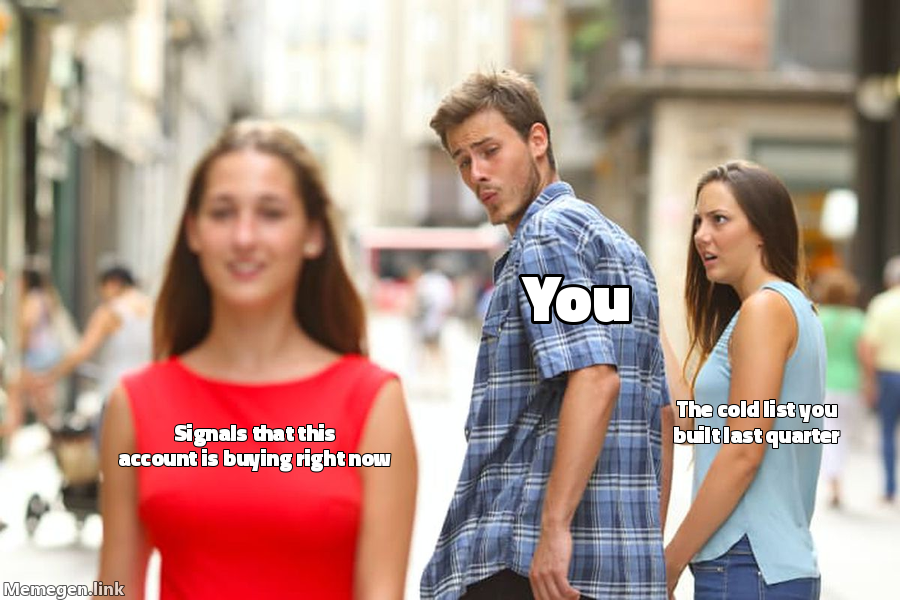 Timing is what separates a booked call from a deleted email.
Hiring signals (highest intent)
-
Posting a job that your product replaces or accelerates. If a company posts for “SDR Manager” or “Sales Operations Analyst,” they are investing in the exact function you might serve. Act within the first two weeks of the posting.
-
A new C-suite or VP hire. New leaders have 90 days to show results and a mandate to bring in new vendors. They want to move fast and own the budget, making them some of the easiest buyers to reach in B2B.
-
Rapid headcount growth. A company that grows from 40 to 80 employees in six months is scaling operations and almost certainly buying new tools to support that growth. Apollo and LinkedIn both surface this data.
Funding and M&A signals
-
Series A, B, or C announcement. Fresh capital means new budget, plus pressure to put it toward growth. Outreach in the first weeks after a funding announcement converts materially better than outreach several months later, after the initial momentum fades.
-
Acquisition. Either side of an acquisition creates buying moments: the acquirer consolidates tools, the acquired company often needs to standardize on new systems.
-
New market entry or product launch. When a company announces expansion into Germany or launches a new product line, their go-to-market needs expand immediately.
Technology and behavior signals
-
CRM or marketing automation change. If a company just moved from HubSpot to Salesforce (visible via job postings, LinkedIn posts, or tools like BuiltWith), they are in evaluation mode and open to adjacent tool conversations.
-
Competitor churn. G2 and Capterra reviews that mention switching from a tool you compete with or complement are public buying signals. A negative review of a competitor posted last week is an active opportunity.
-
Pricing page or case study visits. If you have website intent data (via tools like Clearbit Reveal or RB2B), a known company visiting your pricing page twice in a week is a much warmer outbound target than any cold contact.
Event and intent signals
-
Trade show or conference attendance. If you know a company is attending a relevant event, reference that shared context in your outreach. It converts well because the timing is relevant rather than intrusive.
-
Content consumption (third-party intent). Platforms like Bombora and G2 Buyer Intent track which companies are reading content about problems you solve. A company reading five articles about “SDR automation” this week is an in-market buyer.
-
LinkedIn engagement with your content or competitors’ content. A director who comments on a post about outbound sales is demonstrating interest. Monitoring this at scale, even manually, surfaces warm contacts your competitors are not talking to yet.
How to Operationalize This Checklist
Most teams already know which signals matter. The bottleneck is catching them systematically and routing them to reps before the moment passes.
A practical stack uses Apollo or LinkedIn Sales Navigator for hiring and funding signals, BuiltWith for tech stack changes, and G2 for competitor review monitoring. Clay pulls the data into one enriched record with verified contact details, which then flows into your sequence tool.
If you want to see how this enrichment layer is built in practice, the Clay enrichment service page covers what that workflow looks like end to end.
Prioritizing Your Signal Queue
Not all signals are equal. A rough priority order:
- Tier 1 (act within 48 hours): funding announcement, new executive hire, competitor churn review
- Tier 2 (act within the week): pricing page visit, tech stack change, intent spike
- Tier 3 (act within the month): headcount growth, job posting, conference attendance
Build a signal queue, not a static list. When two or more Tier 1 signals hit the same account in one week, create a personalized, multi-touch priority sequence and send it before someone else reaches the account.
What to Say When You Reach Out
A signal is only useful if you can mention it without sounding like you are monitoring the prospect. Refer to the observable event as context for reaching out now. Do not present it as proof that you have been watching their LinkedIn activity.
For example: “Congrats on the Series B. Teams scaling from here usually hit [specific problem you solve] around the six-month mark. Here is how we helped [category of company] move past it.”
Keep the message short, specific, and timed to the signal.
If your team needs help building the infrastructure to catch and act on these signals at scale, done-for-you outbound or a managed outbound service can get that system running in about a week.
Get the signal tier list in your inbox.
We rank signals from S to D to decide who gets a cold email and who does not. You get the list once. No follow-up emails.
Request received. The list lands in your inbox within 24 hours.
One more step: send the prepared request to faruk@asphia.consulting
FAQ
What are B2B buying signals?
B2B buying signals are observable events that indicate a prospect has a problem they are actively trying to solve. Examples include new executive hires, funding rounds, job postings for roles your product replaces, and technology stack changes. These signals tell you when to reach out, not just who to reach out to.
How do you find buying signals for B2B prospects?
Tools like Apollo, Clay, and LinkedIn Sales Navigator surface signals such as job changes, headcount growth, and funding announcements. Intent data platforms track content consumption. You can also monitor company news, job boards, and G2 or Capterra reviews for technology churn signals.
What is the difference between a buying signal and a pain signal?
A pain signal shows that a company has a problem. A buying signal shows that the company is doing something about it now, such as posting a job, hiring a consultant, or raising capital to invest in a solution. Buying signals take priority because they show current intent.
How many buying signals should trigger outreach?
One strong signal, such as a funding round or a relevant new hire, is enough to justify personalized outreach. Two or more signals from the same account in a short window indicate a strong buying moment. Build a priority sequence for that account instead of adding it to a bulk blast.
Can you automate buying signal monitoring?
Yes. Tools like Clay can pull signals from LinkedIn, Apollo, Crunchbase, and custom webhooks into a single enrichment layer. You can set up workflows that detect trigger events and route those contacts directly into your outreach sequence without manual prospecting.
Do buying signals work for GDPR-compliant outreach?
Yes, when used correctly. Buying signals help you demonstrate legitimate interest, which supports the lawful basis required under GDPR for B2B cold outreach. Reaching out to a company that just hired an SDR team to offer outbound tooling is proportionate and relevant contact.

Ahmet Faruk Yilmaz
Founder of Asphia. He builds and runs signal-based B2B outbound engines for lean teams, and has booked meetings with teams at companies across five markets. Writes about cold email, Clay, deliverability, and GTM engineering.
Want this run for you?
Get a free GTM analysis. We show you the exact engine we would build.
Get your free GTM analysis →