The LinkedIn and Email Multichannel Playbook: Sequence, Timing and Testing
October 27, 2025 · 5 min read · by Ahmet Faruk Yilmaz, Founder of Asphia
TL;DR
Run LinkedIn profile views and connection requests before the first cold email when the context supports it. Treat the sequence as a testable hypothesis, measure meetings and deliverability against a single-channel baseline, and keep channel claims separate.
Running cold email and LinkedIn as one coordinated test can reveal whether channel order and context improve your motion. The sequence should be measured against a comparable single-channel baseline rather than assumed to produce a booked call.
A practical starting hypothesis is to lead with a LinkedIn profile view and connection request, wait two to four days, then send the first cold email. Measure whether recognition changes qualified replies or meetings before standardising the order.
Why Multichannel Works (and Why Order Matters)
Buyers are not sitting at their desk waiting for cold emails. They receive a steady stream of them and delete most without reading. What changes the math is recognition. When a prospect sees your name on LinkedIn before your email arrives, the email stops being cold.
The sequence logic is simple: LinkedIn is a passive, low-friction channel. A profile view costs the prospect nothing. A connection request takes one click. These tiny interactions create familiarity. By the time your email lands, you are not a stranger.
The reverse order (email first, LinkedIn second) also works but is less efficient. The email either gets ignored or deleted, and the subsequent LinkedIn connection looks like a follow-up from someone they already ignored. Front-loading LinkedIn preserves optionality.
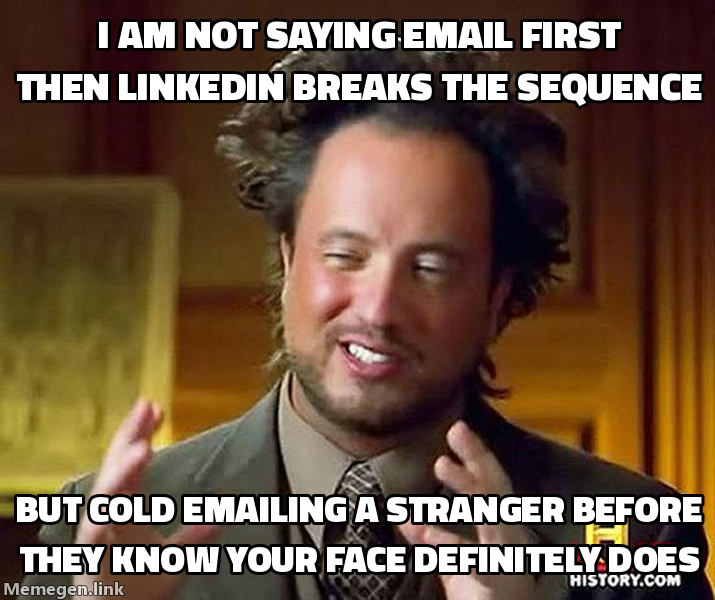 LinkedIn first. Email second. Recognition turns a cold email into a warm one.
The Core Sequence: Day by Day
A reliable multichannel sequence for a ten-to-fourteen day window looks like this:
Day 1: View the prospect’s LinkedIn profile. No message. The notification is the touch.
Day 3: Send a connection request. Keep the note under 200 characters if you include one. Something like “Saw your work on [specific thing], thought it made sense to connect” is a low-pressure variant to test against a pitch.
Day 5: First cold email. Subject line under six words. Body under ninety words. One clear ask. Reference the industry or role, not fake personalization.
Day 8: LinkedIn direct message (if connected) or a follow-up email (if not). Change the angle. If the first email led with the problem, the follow-up can lead with a social proof angle or a different outcome you deliver.
Day 12: Final email or LinkedIn DM. Keep it short: “Happy to close the loop if the timing is off. Worth a quick call?” Treat a low-pressure close as a variant to compare with a repeated pitch.
For a deeper look at structuring cold email steps within this sequence, see our guide on done-for-you cold email and how we run these sequences at scale.
Signal-Based Triggering: When to Launch the Sequence
The biggest testable lever in multichannel outbound may be timing. Launching a sequence the week a prospect posts about hiring, raises a round, or launches a new product line can be compared with a baseline; any reply-rate effect depends on the audience, offer, channel rules, and execution.
Signals worth tracking:
- Job change (prospect moved to a new company or new role in the last ninety days)
- LinkedIn post activity (they are active and engaged, not dormant)
- Company funding, expansion, or product launch
- A competitor you displaced, or one that just lost a customer
Clay is the most practical tool for connecting these signals to your sequences automatically. You can also do this manually for smaller lists. The principle is the same: launch the sequence when the prospect has a reason to care, not on a rigid calendar schedule.
We cover signal-based triggering in more depth in our clay enrichment service and managed outbound service pages.
LinkedIn Outreach Rules That Reduce Account Risk
LinkedIn is protective of user experience and may restrict accounts that send high volumes of generic messages. A few controls to review; account restrictions remain possible:
Use a weekly connection request volume that grows gradually. Starting at thirty per week and scaling to one hundred over four to six weeks is safer than sending one hundred from day one.
Personalize at least the first message field even if the rest of the sequence is templated. Accounts that send identical messages at scale get flagged faster.
Withdraw connection requests that go unanswered after two to three weeks. A high pending-request count is a soft risk signal.
Mix in organic LinkedIn activity (commenting, posting) so your account looks like a real person and not an automation tool.
For teams that want LinkedIn outreach fully managed with account-risk review and conservative controls, see our heyreach agency page. Platform restrictions remain possible.
Measuring What Works
Three numbers matter for multichannel:
Connection acceptance rate (a healthy rate signals good targeting and a compelling note). If it is low, the targeting or the connection note needs work, not the email.
Email open rate by day (track day five opens separately from day eight). A drop between day five and day eight tells you the first email is not landing, not that the sequence is broken.
Reply-to-meeting conversion. Some replies are nos. Track how many positive replies actually convert to a calendar invite. A high reply rate with low conversion usually means the offer or the ICP is off, not the sequence.
If you are comparing tools to run this workflow, our smartlead agency and lemlist agency pages cover the tradeoffs in platform selection.
Running This Without an Internal Team
Most founders and sales leaders cannot dedicate the hours needed to build, monitor, and iterate a multichannel sequence. The targeting needs to be refreshed weekly, the copy needs A/B testing, and the deliverability setup (custom domains, warm-up, SPF/DKIM/DMARC) needs maintenance.
Asphia builds and runs this infrastructure for B2B teams across Europe and beyond. Outbound we run has booked meetings with teams at companies across several markets. The system is built in your stack and yours to keep. See our outbound engine builder page for how the build process works, or services for a full overview.
Request the signal tier list.
A practical view of how we rank observable signals before outreach. We review each request for fit and may reply by email; delivery is not automatic.
By submitting, you agree to processing described in our Privacy Policy.
Your request was submitted. If it is a fit, we may follow up by email.
One more step: send the prepared request to faruk@asphia.consulting
FAQ
What is linkedin and email multichannel outbound?
It is a coordinated prospecting approach where LinkedIn touches (profile views, connection requests, direct messages) and cold emails run on a shared sequence timeline. Each channel reinforces the other so the prospect sees your name more than once before you ask for a meeting.
How many touches does a good multichannel sequence need?
Most sequences that work well run between three and six touches spread over ten to eighteen days. Front-load LinkedIn to build recognition, then switch to email for the direct ask. More touches are fine if you vary the angle and keep messages short.
Does multichannel outbound hurt deliverability?
LinkedIn activity does not directly determine email inbox placement. Measure the channels separately, keep email authentication and list quality in place, and do not assume that a prior LinkedIn touch protects sender reputation.
Should I send the connection request before or after the first email?
Test the connection request two to four days before the first email when that order fits the audience and channel rules. Recognition may change engagement, but open and reply effects need to be measured against your own baseline.
What tools do I need to run multichannel outbound?
At minimum you need a LinkedIn automation tool for sequencing (HeyReach, GetSales, or Expandi), a cold email platform (Smartlead, Lemlist, or Instantly), and an enrichment layer such as Clay or Apollo to sync data across both. A shared CRM or a spreadsheet-based tracker is enough to start.
Is multichannel outbound GDPR compliant?
It can be, depending on the destination market, recipient, data source, and campaign. Keep records of your targeting criteria, document the applicable lawful basis, honor opt-outs immediately across both channels, and respect platform and electronic-marketing rules. An agency can help document controls and responsibilities, but it does not remove the need for campaign-specific legal review.

Ahmet Faruk Yilmaz
Founder of Asphia. He builds and runs signal-based B2B outbound engines for lean teams, and writes about cold email, Clay, deliverability, and GTM engineering.
Want this run for you?
Explore our B2B outbound and GTM engineering services, then request the planning framework to scope your next campaign.
Request the planning framework →