AIDA vs PAS for Cold Email: Which Framework Wins and When to Use Each
December 27, 2025 · 4 min read · by Ahmet Faruk Yilmaz, Founder of Asphia
TL;DR
PAS (Problem, Agitate, Solution) outperforms AIDA in most cold email scenarios because it leads with pain, which earns attention faster. Use AIDA when your offer needs aspiration to land. The right choice depends on buyer awareness, not personal preference.
Short answer: PAS wins in most cold email situations because it leads with the prospect’s pain rather than your offer. AIDA earns its place when the outcome you are selling is more exciting than the problem it solves.
The framework should match what the buyer already knows. Get that wrong and even polished copy gets archived.
What AIDA Actually Looks Like in a Cold Email
AIDA stands for Attention, Interest, Desire, Action.
In cold email the stages map like this:
- Attention: your subject line and first sentence stop the scroll
- Interest: you connect to something relevant in their world (a signal, a role, a recent event)
- Desire: you connect the offer to an outcome the buyer wants
- Action: one clear, low-friction ask
A clean AIDA email for a B2B cold email agency might open: “Saw you recently expanded into DACH. Teams entering a new market usually want pipeline faster than a new hire can ramp.” That is Attention plus Interest in two sentences. The next sentence names the outcome. The CTA is a question, not a calendar link.
AIDA works well when the result is more compelling than the current problem. If your product gives the buyer a new capability rather than fixing a current frustration, use AIDA to show what that capability changes.
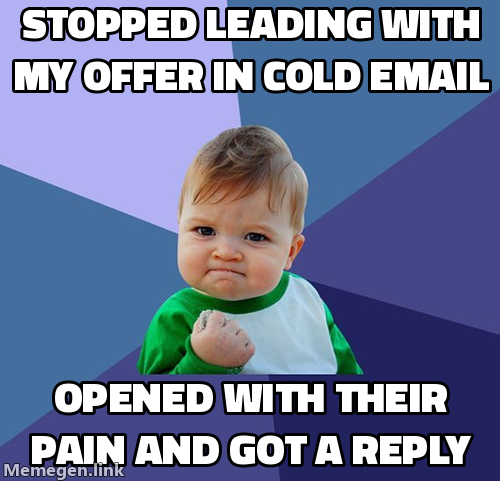 PAS in practice: one mindset shift, one reply.
When PAS Outperforms AIDA
PAS stands for Problem, Agitate, Solution.
It earns attention faster in cold email because it skips the buildup and names the thing the prospect is already thinking about. The structure:
- Problem: state the specific pain in their language
- Agitate: make the cost of the problem feel real without exaggerating
- Solution: position your offer as the most direct path out
Example: “Most SDR teams spend two weeks cleaning a lead list before a single email goes out. That is two weeks of quota time that never comes back.” That is PAS in two sentences. The solution is the next line.
PAS works better when your buyer is already aware of the problem. Tactical buyers (RevOps leads, heads of sales, growth engineers) often respond faster to pain than to promise. They have the problem on their to-do list. You are offering to move it off.
For done-for-you cold email or fractional SDR services, PAS tends to convert better because the prospect is usually searching for a fix, not dreaming about growth.
How to Choose Based on Buyer Awareness
The awareness level of your prospect drives the choice more than any other variable.
| Buyer awareness level | Better framework |
|---|---|
| Problem-unaware or aspirational | AIDA |
| Problem-aware, solution-shopping | PAS |
| Solution-aware (knows your category) | PAS with a comparison angle |
| Brand-aware (knows you) | Neither, write conversationally |
One practical test: read your prospect’s LinkedIn headline or company job posts. If they are hiring for the thing you solve, they are problem-aware. Use PAS. If they are posting about growth goals and new markets, try AIDA.
Mechanics That Matter More Than the Framework
Experienced outbound teams choose the framework after getting four basics right:
Specificity of the opening line. A generic opener kills both AIDA and PAS. Signal-based personalization (a funding round, a new hire, a tech stack change) earns the read that lets the framework do its work. This is core to how we build AI cold email at Asphia: signals first, structure second.
One idea per email. Both frameworks fail when the email tries to introduce the company, explain the offer, share a case study, and make an ask in 90 words. One thesis per send. One CTA.
The CTA friction level. “Would this be worth 15 minutes?” converts better than “Book a call here” in most cold contexts. It asks for a reply before asking the buyer to open a calendar.
Subject line. For AIDA, the subject is the Attention stage. Make it specific and slightly unexpected. For PAS, the subject can name the problem directly or be deliberately plain (plain text often outperforms clever).
A Simple Decision Rule
If your one-sentence description of what you sell starts with a verb that improves or unlocks something, use AIDA. If it starts with a verb that fixes or eliminates something, use PAS.
If you are building outbound for B2B SaaS companies or agencies where the pain is well-documented and buyers are already hunting for solutions, default to PAS. You can always A/B test the AIDA variant once you have a baseline reply rate to beat.
Neither framework rescues bad copy. Start with a relevant signal, choose the structure that matches buyer awareness, then compare reply rates.
Get the signal tier list in your inbox.
We rank signals from S to D to decide who gets a cold email and who does not. You get the list once. No follow-up emails.
Request received. The list lands in your inbox within 24 hours.
One more step: send the prepared request to faruk@asphia.consulting
FAQ
What is the AIDA framework in cold email?
AIDA stands for Attention, Interest, Desire, Action. In cold email you open with a hook that earns attention, build interest with relevant context, create desire by connecting your offer to an outcome the prospect wants, then close with a single low-friction call to action.
When should I use PAS instead of AIDA for B2B cold email?
Use PAS when your prospect is already aware of the problem you solve. PAS opens by naming the pain directly, agitates it briefly to make the cost real, then positions your solution. It works best for tactical buyers who care more about fixing something than chasing a new outcome.
How long should an AIDA cold email be?
Keep the whole email under 120 words. Each AIDA stage gets roughly one sentence. Attention is your subject line, Interest is sentence one, Desire is sentences two and three, Action is your final line. Longer emails rarely perform better in cold outbound.
Can I combine AIDA and PAS in one cold email?
Yes, and experienced copywriters do it. A common hybrid opens PAS-style (name the pain, agitate it), then shifts to AIDA-style desire (paint the outcome) before the CTA. The key is that you never have more than one idea per sentence at this word count.
Does the AIDA framework work for LinkedIn cold outreach too?
AIDA works for LinkedIn connection requests and InMail, but even shorter. Your attention hook is the first visible line before the fold. Interest and desire collapse into one sentence. Action is a single soft question, not a calendar link.
What makes a cold email framework fail regardless of AIDA or PAS?
Generic openers, fabricated social proof, and a CTA that asks for too much commitment. No framework rescues an email that starts with 'I hope this finds you well' or claims results it cannot back up. Signal-based personalization matters more than which framework you pick.

Ahmet Faruk Yilmaz
Founder of Asphia. He builds and runs signal-based B2B outbound engines for lean teams, and has booked meetings with teams at companies across five markets. Writes about cold email, Clay, deliverability, and GTM engineering.
Want this run for you?
Get a free GTM analysis. We show you the exact engine we would build.
Get your free GTM analysis →