Multilingual cold email: an operating guide for TR, DE, NL and AR
June 15, 2026 · 5 min read · by Ahmet Faruk Yilmaz, Founder of Asphia

TL;DR
Assess language, context, channel rules, sending infrastructure and test plans independently for every market. This guide is not a benchmark or a results guarantee.
Translation is only one part of a language and context decision. When adapting a message for Germany, the Netherlands, Turkey or the Gulf, assess the audience, offer, channel rules and local business language together. This guide describes operating choices you can test; it is not a performance benchmark.
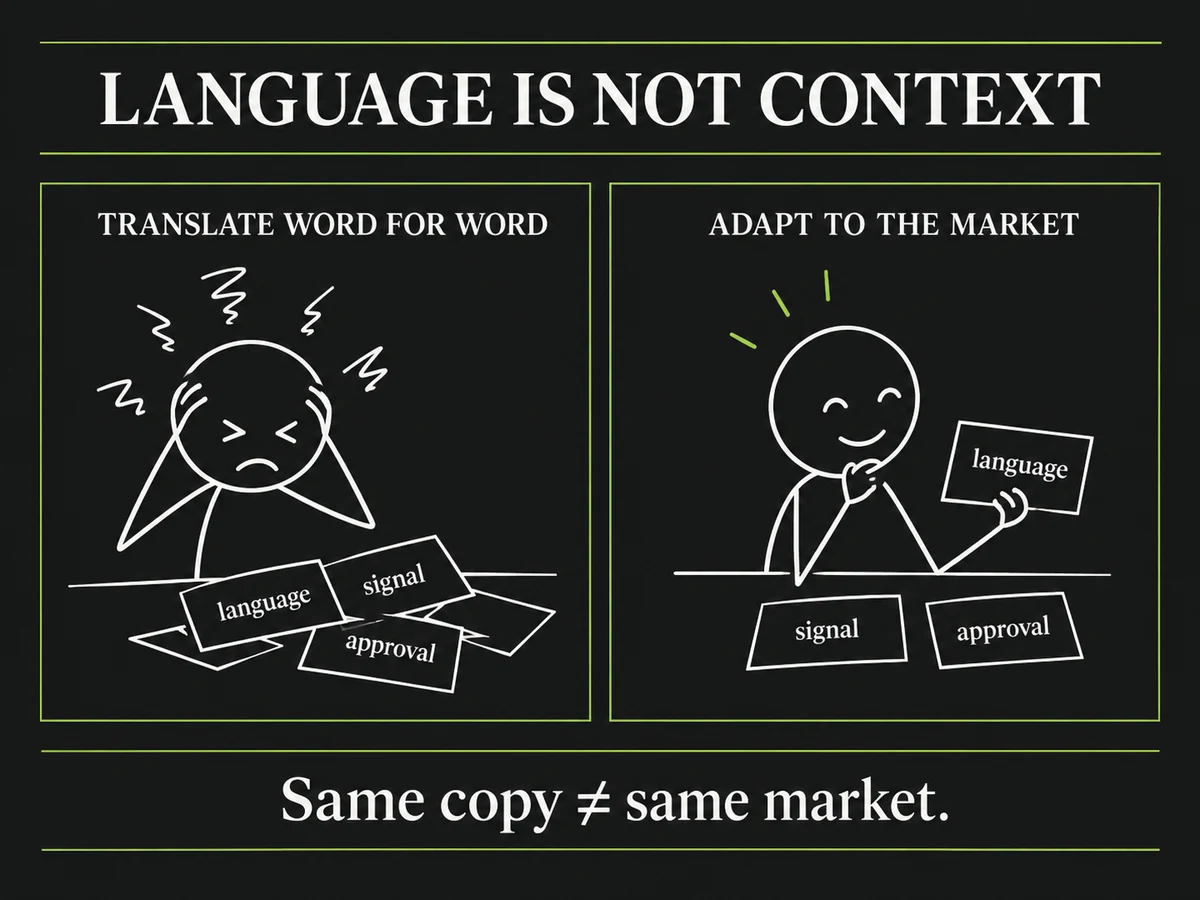
Same copy ≠ same market.
When translation may need adaptation
Translation moves words, but may not carry the offer, terminology or context that a specific audience expects. Treat the need for a translation, rewrite or native review as a testable decision.
Three areas to review when adapting a message:
- Terminology and sentence rhythm. Check whether the draft uses the language and terms the intended audience actually uses.
- Message construction. Check capitalization, formatting, links and sender identity against your delivery and policy controls.
- The ask. Test whether the proof, request and level of directness fit the specific audience and use case.
Test a translation against a rewrite on comparable audience segments and offers. Record total replies, positive replies and qualified conversations separately, and document the sample size and conditions before generalising a difference.
What actually changes per market
Treat each language as an independently scoped campaign, not a locale toggle. The copy, formality, proof and timing are hypotheses to validate with the intended audience.
| Market | Language | Starting hypothesis | What to test | Timing approach |
|---|---|---|---|---|
| Turkey | Turkish | Confirm whether formality and context match the segment | Terminology, proof and ask | Small audience-specific time-window tests |
| Germany | German | Confirm the appropriate register with a reviewer and audience evidence | Relevance, specificity and terminology | Small audience-specific time-window tests |
| Netherlands | Dutch | Confirm the appropriate register with a reviewer and audience evidence | Clarity, proof and ask | Small audience-specific time-window tests |
| Gulf / MENA | Arabic | Confirm language, audience and regional context with a reviewer | Rendering, greeting, proof and ask | Small audience-specific time-window tests |
Germany: validate the register and relevance
Use audience research and a native reviewer to decide the appropriate register, terminology and level of specificity. Test the relevance explanation and request on small, comparable segments rather than treating one style as a country-wide rule.
Netherlands: test clarity and the ask
Test concise and more contextual variants with the intended segment. Keep the offer and measurement conditions comparable so the result tells you about the message rather than a changed audience.
Turkey: test context and formality
Confirm how the segment expects to be addressed and which context is genuinely relevant. Test local references and the request only where the supporting source information is accurate and approved.
Arabic and the Gulf: validate language and rendering
Confirm the specific audience, country and language variant before drafting. Review right-to-left rendering where relevant, and test timing around the audience’s working patterns and holidays rather than applying a regional default.
Infrastructure controls to assess before sending
Multilingual outbound adds operational variables. Define the sender, domains, authentication, review path and monitoring approach before sending, then assess results against your own risk criteria.
- Domain separation. Decide whether language or market separation is appropriate for the relevant risk and ownership model.
- Sender identity. Review the selected domain, identity and legal notices for the target market and campaign.
- Ramp-up and volume controls. Document the initial volume, monitoring threshold and change approval policy; adjust based on observed delivery signals.
- Validation and suppression. Define the address-validation, suppression and objection process before launch.
- Timing tests. Schedule controlled tests in the recipient’s time zone and record the conditions.
Tooling does not replace operating controls. Follow applicable provider requirements, including Google’s Email sender guidelines, and validate the implementation for the accounts and volume you actually use.
Build lists with a documented legal and operational review
Cross-border outreach may involve different privacy, marketing and platform rules. This section is an operational checklist, not legal advice.
Review at least the following with the appropriate owners and counsel:
- Purpose and legal basis. Document the campaign purpose, data source, recipient type and legal assessment for the relevant jurisdiction.
- Targeting and data minimisation. Use only data and fields that are relevant to the approved purpose.
- Objections and suppression. Provide and honour the required objection, opt-out and suppression process.
- Local review. Confirm country-specific requirements, especially before adding a new market or channel.
Document each source, enrichment step, approval and suppression rule. Validation and enrichment can support operational quality, but do not by themselves establish legal compliance or suitability.
How to run a four-language campaign end to end
Use an operating sequence such as:
- Define the audience and approval criteria. Document the intended recipients, source rules, offer and decision owner for each market.
- Prepare and review language variants. Use a rewrite or native review appropriate to the audience, with source context for each material claim.
- Configure the sending controls. Set the approved domains, sender identities, validation checks, monitoring and change approvals.
- Run controlled timing tests. Test a small number of recipient-time-zone windows and record the conditions.
- Route replies and learn. Assign the response owner, tracking definitions and feedback path before launch.
Track total replies, positive replies, qualified meetings, objections and delivery signals using consistent definitions. If one market changes, isolate the tested variable where possible instead of transferring a conclusion to every other market.
Build your own baseline
Create a baseline that records the audience, offer, channel, data source, sender setup, date range and metric definitions. Review at least:
- Total and positive replies: Separate the two measures and retain the denominator.
- Qualified meetings: Define qualification before the test begins.
- Delivery and objections: Track delivery signals, unsubscribe or objection events, and any required suppression action.
- Learning quality: Record what changed, who approved it and whether the audience conditions were comparable.
Treat every language as an independently owned operating loop. A documented test, review and approval process is more useful than a universal country-level promise.
Request the signal tier list.
A practical view of how we rank observable signals before outreach. We review each request for fit and may reply by email; delivery is not automatic.
By submitting, you agree to processing described in our Privacy Policy.
Your request was submitted. If it is a fit, we may follow up by email.
One more step: send the prepared request to faruk@asphia.consulting
FAQ
Should I translate my English cold email or rewrite it per language?
Consider rewriting or having a native reviewer assess the message for its audience and context. Translation alone does not establish local business-language, offer or channel fit.
Is cold email legal in Germany and the Netherlands?
Requirements depend on jurisdiction, recipient type, channel, data source, purpose and your organisation's documented legal basis. Obtain local advice for the campaign and apply the required suppression and objection controls.
What reply rate should I expect across TR, DE, NL and AR?
There is no universal market-level reply-rate benchmark. Set a baseline for your own audience, offer, data quality, channel and sender infrastructure, then track total replies, positive replies and qualified meetings separately.
Do I need separate email domains for each language market?
Domain separation, authentication, ramp-up and volume controls should be assessed against the campaign's risk profile. These controls may reduce risk; they do not guarantee deliverability or reputation.
Can I use AI to write multilingual cold emails?
AI can help structure a draft. Review the final message for the intended audience, language, source context and approval policy before sending.
What is the right sending schedule for Gulf and MENA markets?
Plan small test windows around the audience's time zone, working patterns, holidays and platform behaviour. Do not assume a single sending time applies to every country or region.

Ahmet Faruk Yilmaz
Founder of Asphia. He builds and runs signal-based B2B outbound engines for lean teams, and writes about cold email, Clay, deliverability, and GTM engineering.
Want this run for you?
Explore our B2B outbound and GTM engineering services, then request the planning framework to scope your next campaign.
Request the planning framework →