LinkedIn Outreach for Fintech Startups: Sequences, Signals, and Compliance
February 14, 2026 · 5 min read · by Ahmet Faruk Yilmaz, Founder of Asphia
TL;DR
Fintech startups can test LinkedIn outreach by triggering sequences on intent signals (funding rounds, compliance hires, new product launches) rather than blasting lists. Keep connection notes short, reference something real, and review GDPR requirements from day one. Measure qualified replies and account health; no setup removes restriction risk.
Fintech startups need pipeline fast, but their buyers are skeptical and busy. LinkedIn outreach works when it is signal-driven and compliant. It fails when it looks like everyone else’s sequence.
The short answer: trigger your LinkedIn sequences on real intent signals, keep your notes short and specific, and treat GDPR compliance as a feature rather than a checkbox. That combination is a testable design: measure qualified replies and account health against a comparable baseline; it does not guarantee bookings or prevent reports.
Why LinkedIn Works Differently for Fintech
Fintech buyers sit at the intersection of technology and regulation. That means two things for your outreach:
First, they are active on LinkedIn because the industry moves fast and professional reputation matters. A CFO at a payments company, a Head of Compliance at a neobank, or a VP of Engineering building BaaS infrastructure all use LinkedIn to track competitors, follow regulatory news, and signal their own expertise. They are reachable.
Second, they are unusually good at pattern-matching sales outreach. They see the same templates everyone else sees. A generic “I help fintech companies grow revenue” opener may be ignored; test contextual alternatives against a baseline.
The implication is not to avoid LinkedIn. It is to earn the right to a response by demonstrating that you understand their specific context. That starts with signals.
Signal-Based Triggering: What to Watch and When to Send
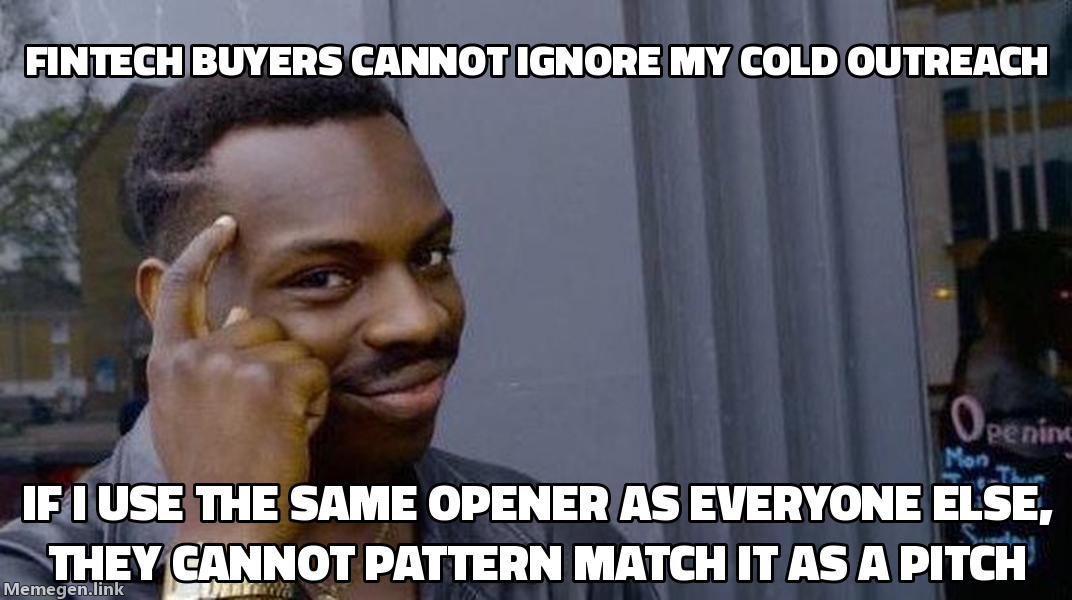 Fintech buyers pattern-match generic openers faster than your email loads. Use a real signal or do not send.
A signal is a public event that indicates a buyer is likely experiencing a problem you can solve. For fintech outreach, the highest-value signals are:
Funding rounds. A Series A or B means the company has budget and is likely building out a new function. If your solution helps scale operations, that is exactly when a COO or Head of Revenue needs to hear from you. Pull funding data from Crunchbase or Apollo and build sequences that trigger within two to three weeks of the announcement.
Compliance and risk hires. If a fintech company just hired a Head of AML, Chief Compliance Officer, or VP of Risk, they are acknowledging a pain point. That hire is your intro. Reference the role, not the person’s name.
Product launches and feature announcements. A payments startup launching a new card programme or a lending platform entering a new market often needs infrastructure, data, or tooling they did not need before. Their announcement is your opening.
Content signals. If a decision-maker publishes a post about a challenge your product addresses, you have the strongest possible context for a connection note. A one-line reference to their post beats any template.
Tools like Clay enrichment let you automate signal detection and build dynamic lists that update as these events happen, rather than working off a static CSV that ages out within weeks.
Writing the Connection Note and Follow-Up Sequence
The LinkedIn connection note has one job: get accepted. It is not a pitch. The structure that works:
- Reference something real and specific (the signal, a post, a shared context).
- State in one sentence what you do or why you are connecting.
- No ask. No “would love to chat.” Let the acceptance open the conversation.
After acceptance, your first message does the actual work. Keep it under four sentences. One line of context, one line of what you do, one line of why it is relevant to them now, one soft question or CTA. No decks, no case studies in the first touch.
The follow-up cadence for fintech buyers should be slower than in other verticals. Two to three touches over three to four weeks is enough. Fintech buyers make decisions carefully and they remember aggressive sequences.
If you are running LinkedIn alongside cold email, coordinate the timing so the channels reinforce each other rather than creating the impression of two different companies reaching out simultaneously. A managed outbound service can handle the sequencing logic across channels so nothing overlaps awkwardly.
Compliance Considerations That Fintech Buyers Notice
Fintech buyers work in regulated industries. How you sell to them signals how you operate. A few things matter here:
GDPR-native defaults. When reaching out to EU-based fintech teams, legitimate interest is a viable lawful basis for B2B outreach, but your note should make it easy to opt out and should be genuinely relevant to the recipient’s role and context. Buyers in Frankfurt, Amsterdam, and London have seen enough spray-and-blast outreach to recognise it immediately, and some will report it.
No deceptive personalisation. Fintech buyers are technical. They can tell the difference between a note that references something real and a template with their company name swapped in. False personalisation is worse than no personalisation.
Sender account health. If your connection acceptance rate falls consistently below 30 percent, your account is at risk and your message is probably off. That is a quality signal, not a volume problem.
If GDPR compliance across multiple European markets is a concern, a GDPR-compliant cold email agency that applies the same standards to LinkedIn outreach can reduce risk while maintaining send volume.
Combining LinkedIn With Cold Email for Fintech GTM
LinkedIn alone is rarely enough to build a repeatable pipeline for a fintech startup. The highest-performing outbound motions layer LinkedIn connection sequences with cold email so buyers see you across two channels with a coherent message.
The typical structure: LinkedIn connection attempt on day one, email touch on day three if the connection is pending, LinkedIn follow-up message on day seven after acceptance, email follow-up on day ten. Each touch references the same core signal and the same specific value proposition.
This coordination requires clean data and tooling that can suppress duplicate touches if a prospect replies on either channel. If you are building this in-house, the outbound engine builder approach lets you own the infrastructure rather than renting agency capacity indefinitely.
For fintech startups that want to move faster without hiring an SDR, the done-for-you cold email model or a fractional SDR service can run the full LinkedIn and email motion while you focus on closing the meetings that come in.
Signal-based outreach in fintech takes longer to set up correctly, but it produces meetings with buyers who already understand why you are relevant. That is a much better starting point than a cold call from a list that was pulled last quarter.
Request the signal tier list.
A practical view of how we rank observable signals before outreach. We review each request for fit and may reply by email; delivery is not automatic.
By submitting, you agree to processing described in our Privacy Policy.
Your request was submitted. If it is a fit, we may follow up by email.
One more step: send the prepared request to faruk@asphia.consulting
FAQ
Is LinkedIn outreach effective for fintech B2B sales?
They can be useful for deals involving compliance or risk buyers who are active on LinkedIn but rarely respond to cold email. Test signal-based sequences targeting job-change, funding, or product-launch triggers against a comparable spray-and-blast baseline; outcomes vary by fintech segment, offer, and execution.
How many LinkedIn connection requests can a fintech startup send per week?
There is no reliable universal weekly threshold. Figures such as 100 to 150 requests are planning references, not a safe ceiling; account age, acceptance, activity and current platform rules affect restriction risk. Ramp conservatively and monitor the account rather than assuming warm-up removes risk.
What signals should trigger a LinkedIn outreach sequence for fintech?
Useful research triggers include a Series A or B announcement, a compliance or risk hire, a new product announcement, or a decision-maker publishing about a problem you address. Treat these as reasons to investigate and qualify—not proof of budget, pain, or purchase intent.
Does GDPR apply to LinkedIn outreach for fintech startups targeting European buyers?
Yes. LinkedIn messages are covered under GDPR when they involve processing personal data of EU residents. Legitimate interest is the most common lawful basis used by B2B senders, but the outreach must be relevant, expected in context, and include a clear opt-out. Fintech buyers in regulated markets notice compliance posture in how you sell.
Should fintech startups combine LinkedIn and cold email outreach?
A multichannel sequence (LinkedIn connection followed by email, or email then LinkedIn touch) may affect reply rates by creating multiple low-friction touchpoints. Measure it against an email-only or LinkedIn-only baseline; coordinate timing and message across channels so it feels like a coherent conversation, not spam.
How is LinkedIn outreach for fintech different from other verticals?
Fintech buyers (CFOs, Heads of Compliance, Treasury leads) have high noise tolerance but low trust. Generic outreach may be ignored quickly. References to specific regulatory events, product verticals (embedded finance, BaaS, payments infrastructure), or recent company news are hypotheses to test against a comparable template-first baseline; response varies by segment, offer, and execution.

Ahmet Faruk Yilmaz
Founder of Asphia. He builds and runs signal-based B2B outbound engines for lean teams, and writes about cold email, Clay, deliverability, and GTM engineering.
Want this run for you?
Explore our B2B outbound and GTM engineering services, then request the planning framework to scope your next campaign.
Request the planning framework →