B2B Lead Scoring Model Checklist: 12 Signals That Actually Predict Pipeline
November 17, 2025 · 4 min read · by Ahmet Faruk Yilmaz, Founder of Asphia
TL;DR
A B2B lead scoring model that predicts pipeline combines firmographic fit (company size, industry, tech stack) with behavioral signals (intent data, hiring patterns, job changes, engagement timing). The 12 signals below separate accounts that are actively buying from ones that look good on paper but will not convert.
A useful B2B lead scoring model separates accounts with an active buying trigger from good-fit accounts with no reason to change vendors today. The 12 signals below make that distinction. Most models miss half of them, then leave sales wondering what the score is for.
Why Most Lead Scoring Models Fail
The common mistake is scoring curiosity as intent. Email opens, page visits, and webinar registrations measure attention. A lead who watched your demo video twice is interesting. A lead whose company just posted three SDR roles, raised a Series A, and whose VP of Sales changed jobs last month has reasons to buy.
The first lead opened your email. The second has a business problem your product solves, a fresh budget cycle, and a decision-maker with something to prove. The scores should not be close.
Activity-based scoring rewards marketing engagement over buying behavior. That is why sales teams ignore it. The model penalizes a Fortune 500 ICP that went quiet for two months but is ready to close, then rewards a two-person startup that clicks every link and has no budget. Calibrate against closed-won deals, not MQLs or pipeline. Anything else optimizes for the wrong outcome.
The 12 Signals Worth Scoring
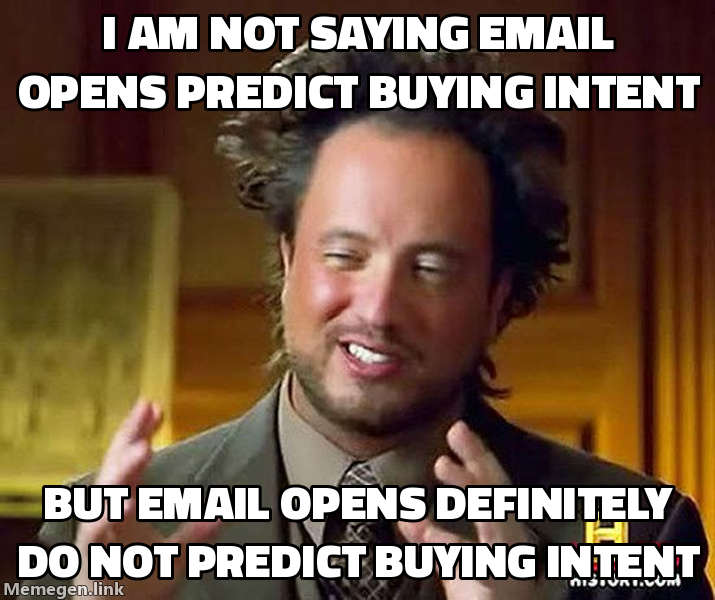 Scoring curiosity is not the same as scoring intent.
Firmographic fit (foundation layer, not predictor)
These signals confirm whether an account belongs in your market at all. They set the ceiling on how high a score can go, but they do not tell you when to reach out.
- Company headcount in your target range
- Industry and vertical match
- Tech stack overlap (CRM, marketing stack, infrastructure tools relevant to your product)
- Revenue or funding stage alignment with your buyer profile
Assign moderate weight to these. A perfect firmographic fit with no behavioral signal is still a cold account.
Intent and timing signals (the actual predictors)
These signals show that something changed at the company or with the contact. That creates a limited window for outreach. Put most of the model’s weight here.
- Job change at a key contact (the new VP inherits a problem and wants to solve it quickly)
- Hiring for a role your product replaces or supports (posting for a manual analyst when you sell automation)
- Recent funding announcement (new budget, growth mandate, pressure to build infrastructure)
- Tech stack change detected (dropped a competitor tool, added a category-adjacent product)
- Leadership hire in a function relevant to your product (new CRO, new Head of Revenue Ops)
- Third-party intent data showing category research (tools like Bombora or G2 intent signals)
Each signal gives you a reason to reach out today instead of next quarter. One strong intent signal on an in-profile account should score higher than perfect firmographic fit with no recent activity.
Engagement signals (directional, not definitive)
These are worth including, but at lower weights than intent signals.
- Direct engagement with your content (demo request, pricing page visit, comparison content)
- Response to a prior outbound touch (replied to a cold email, connected on LinkedIn)
A cold outreach reply confirms that a person noticed you. A pricing page visit suggests active evaluation. Both belong in the model, but neither should outweigh a job change or funding event.
Building the Model in Practice
Start with your CRM data on closed-won deals from the last 12 months. For each deal, identify which signals were present at the time of first contact or first reply. That pattern is your ground truth. Build your weights from it, not from marketing instinct.
An enrichment layer should collect live signals before they reach your CRM. Tools like Clay enrichment can put job changes, hiring signals, funding news, and tech stack data into one row per account. Without that layer, the model is limited to data that contacts volunteered. That rarely includes the signals that matter.
Once the model is live, connect it to your outbound workflow. A high score should trigger specific outreach soon after the signal appears, not wait in a queue for the weekly review. A managed outbound service or structured outbound engine can handle that response. Without fast execution, the score creates no value.
The Recalibration Habit
A scoring model degrades when left alone. Markets shift. Your ICP evolves. A signal that predicted pipeline six months ago may now be common knowledge. Review the model quarterly: pull closed-won deals, check which ones scored high before first contact, and find patterns among the fastest closes. Increase the weights on what those deals had in common.
Treat lead scoring as a live system, not a setup task. Every closed deal with properly logged signals gives you another data point. Over time, the score becomes a filter that sales can trust and act on within hours.
See how to book meetings without an SDR for the execution layer and AI-run cold email for using these signals in personalized outreach.
Get the signal tier list in your inbox.
We rank signals from S to D to decide who gets a cold email and who does not. You get the list once. No follow-up emails.
Request received. The list lands in your inbox within 24 hours.
One more step: send the prepared request to faruk@asphia.consulting
FAQ
What is a B2B lead scoring model?
A B2B lead scoring model assigns numeric weights to firmographic and behavioral attributes so your team knows which accounts to contact first. It combines static fit data (industry, headcount, tech stack) with live signals (job changes, hiring intent, engagement behavior) to rank leads by actual buying likelihood.
What signals matter most in a B2B lead scoring model?
Behavioral signals outperform firmographic ones for timing. Hiring for a role your product replaces, a contact changing jobs to a new company, recent funding, and tech stack changes are the highest-confidence purchase triggers. Firmographic data (size, industry) filters for fit but does not predict when someone will buy.
How many points should I assign to each lead scoring signal?
There is no universal scale. Most teams use a 0 to 100 range, weighting intent signals (hiring, funding, job change) at 15 to 25 points each and firmographic fit at 5 to 10 points per attribute. The exact weights should be calibrated against closed-won deals in your CRM, not guessed upfront.
Should I build a lead scoring model in my CRM or a separate tool?
Start in your CRM if you already have clean data there. HubSpot and Salesforce both support custom scoring. For signal-based scoring that pulls live data (job postings, LinkedIn changes, funding news), you need an enrichment layer like Clay between your data sources and your CRM before scoring makes sense.
What is the difference between MQL and lead scoring?
MQL is a threshold: a lead crosses a line and becomes a marketing qualified lead. Lead scoring is the system that generates the number used to cross that line. A good scoring model means your MQL threshold catches actual buying intent rather than just email opens or page visits.
How often should I recalibrate my B2B lead scoring model?
Recalibrate every quarter by comparing scored leads against pipeline outcomes. If accounts with high scores are not converting, the weights are wrong. Most teams over-weight engagement data (email opens, site visits) and under-weight intent signals (job changes, competitor research, hiring patterns).

Ahmet Faruk Yilmaz
Founder of Asphia. He builds and runs signal-based B2B outbound engines for lean teams, and has booked meetings with teams at companies across five markets. Writes about cold email, Clay, deliverability, and GTM engineering.
Want this run for you?
Get a free GTM analysis. We show you the exact engine we would build.
Get your free GTM analysis →